
Dressings & Wet Gauze (Patient Version)
1. First, understand: a dressing is a tool that helps healing — not a cure-all
A dressing can protect the wound, soak up fluid, and reduce pain and rubbing. It also helps keep the wound in a good environment for healing. But if the wound is caused by diabetes, poor circulation, constant pressure, infection, or poor nutrition, changing the dressing alone is usually not enough.
| What can a dressing do? | In plain words |
|---|---|
| Protect the wound | Like putting a cover over the wound to block rubbing, dust, and dirt |
| Soak up fluid | Absorbs the fluid coming out of the wound so it doesn't wet your clothes or turn the nearby skin white and soggy |
| Reduce pain | Some dressings don't stick as much, so pulling them off hurts less and causes less bleeding |
| Keep moisture balanced | A wound that is too dry or too wet heals poorly; the right dressing keeps it just moist enough |
| Lower infection risk | Some antimicrobial dressings can reduce germs on the wound, but they cannot replace a doctor's judgment |
2. Check the wound before each dressing change
Each time you change the dressing, look at the wound in the same order. This helps you see whether the wound is getting better, and lets you clearly describe the changes to your care team at your next visit.
| What to check | How to look | Changes that need attention |
|---|---|---|
| Size | Is the wound getting smaller, bigger, or deeper? | If it has not gotten smaller in 2–4 weeks, go back for a check-up |
| Color | Red healthy tissue, yellow dead tissue, black scab, or white soggy skin | More black, more yellow dead tissue, or white soggy skin all need attention |
| Fluid (drainage) | How fast the dressing soaks through; the color and smell of the fluid | A sudden increase, a bad smell, or pus means you should see your doctor |
| Pain | Does it hurt during dressing changes? Is it hurting more over time? | A sudden rise in pain can be a warning sign of infection or poor blood flow |
| Nearby skin | Is the skin around the wound red, swollen, white and soggy, broken, or itchy? | Damaged nearby skin can make the wound bigger with each change |
| Whole body | Fever, chills, out-of-control blood sugar, or feeling much weaker | See a doctor promptly if you have whole-body symptoms |
Tip: Take photos, measure the size, and note the fluid and pain each time. This makes it much easier for your care team to judge whether the current dressing is right. When taking photos, use the same distance, lighting, and angle, and place a clean ruler next to the wound.
3. A simple guide to common dressings
There are many kinds of dressings. You don't need to memorize brand names — just know what each type is mainly used for.
| Dressing type | Simple function | Common uses | Reminder |
|---|---|---|---|
| Gauze | Basic cover and absorption | Short-term protection or when the wound needs frequent checks | May stick if placed directly on healing tissue — painful to pull off |
| Non-adherent dressing | Less likely to stick to the wound | Painful wounds, new skin growth, wounds that bleed easily, fragile skin | Usually needs an absorbent layer on top if there is a lot of fluid |
| Silicone dressing | Low-tack, gentler on skin | Elderly skin, skin tears, pressure injuries, painful wounds | Needs an absorbent dressing on top if the wound leaks a lot |
| Transparent film | Waterproof; you can see the wound | Very shallow wounds with very little fluid | Not suitable for infected or heavily draining wounds |
| Hydrogel | Adds moisture to dry wounds | Dry wounds or dry dead tissue | Do not use on your own if the wound is very wet, clearly infected, or has a black scab from poor blood flow |
| Foam | Absorbs fluid and cushions | Moderate to heavy fluid, pressure injuries, venous ulcers | Not always suitable for dry wounds |
| Alginate / gelling fiber | Absorbs more; can fill deep holes | Wounds with heavy fluid or a cavity | Do not pack tightly; make sure it is fully removed |
| Superabsorbent dressing | Soaks up large amounts of fluid | Heavy fluid, venous ulcers, cancer-related wounds | Padding that is too thick can create pressure |
| Antimicrobial dressing | Helps control germs on the wound | When a clinician judges there is infection risk | Do not use long-term on your own; it cannot replace antibiotics |
| Activated charcoal dressing | Helps reduce odor | Foul-smelling wounds, such as cancer-related or infected necrotic wounds | Usually unnecessary if there is no odor |
4. Which dressing direction fits which wound?
This is not for self-diagnosis. It is to help you understand why your care team chooses a certain type of dressing.
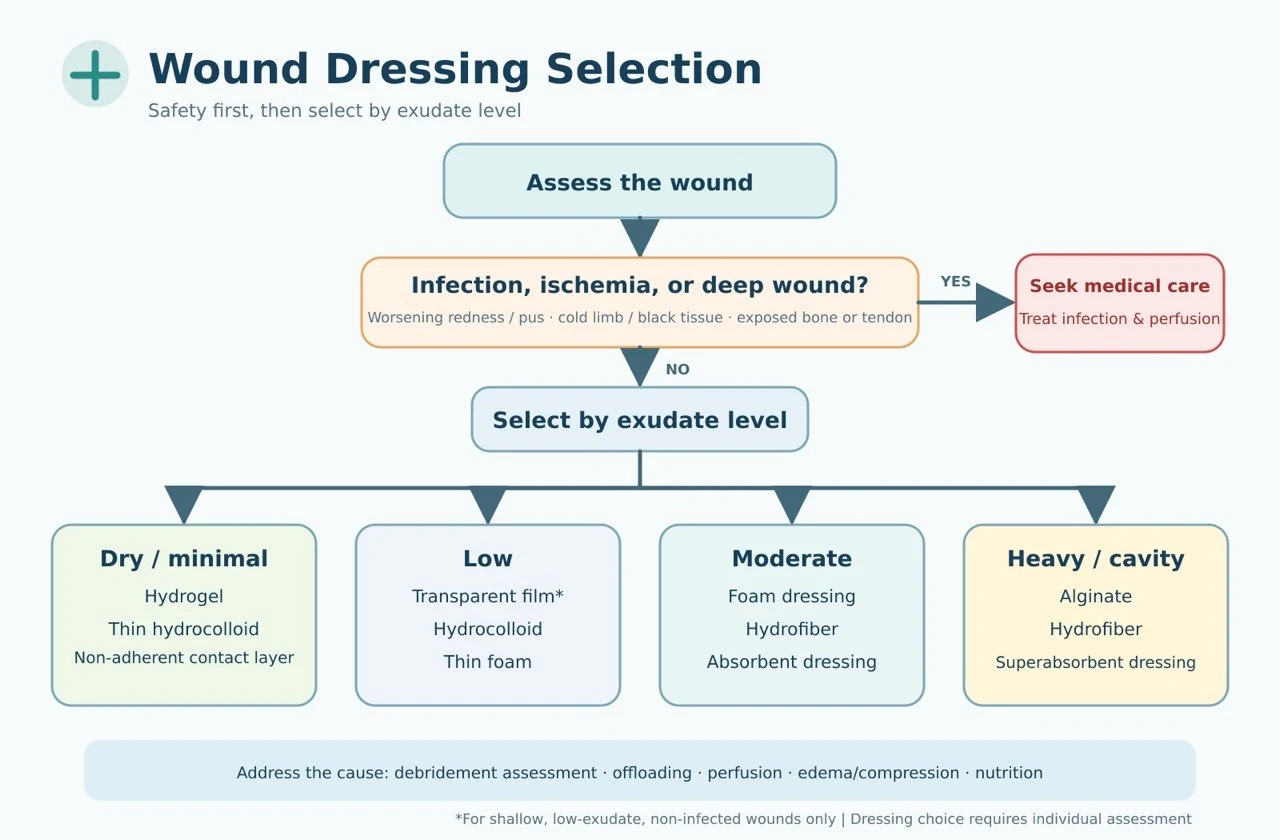
| The wound looks like | Likely dressing direction | What you should watch |
|---|---|---|
| Dry, with little fluid | Moisturizing or non-adherent dressings | If a toe has a dry black scab, do NOT wet it yourself — see a doctor to check blood flow first |
| Lots of fluid; dressing soaks through often | More absorbent dressings (foam, superabsorbent, alginate, gelling fiber) | Also look for the cause: infection, swelling, or vein problems |
| Yellow dead tissue or debris | May need debridement or dressings that help remove dead tissue | Do not scrape or cut it yourself |
| Bad smell | May need antimicrobial or odor-control dressings | See your doctor if the smell gets worse, pus increases, or you have a fever |
| A deep hole | May need a filler / packing dressing | Do not pack tightly; if unsure, let the care team handle it |
| Very painful changes or easy bleeding | Non-adherent or silicone contact layer | Never rip off dry gauze by force |
| Nearby skin white, soggy, or broken | More absorption plus protection for the nearby skin | Change the dressing earlier when it soaks through |
5. Basic steps for changing a dressing at home
Wash your hands. Set up a clean table, dressings, tape or bandage, a trash bag, and the cleaning supplies your care team recommended.
Peel it off slowly. If it sticks, do not force it — wet it with normal saline first (as instructed) and remove it once it loosens.
Check size, color, fluid, smell, pain, and the nearby skin. Take a photo if needed.
Use normal saline or the method your care team taught you. Do not use harsh solutions on your own.
Place the contact layer, then the absorbent layer, then secure it. Do not wrap too tightly.
Put the old dressing in a trash bag and wash your hands again. If infection is suspected, follow your care team's instructions for disposal.
A dressing change is not just putting on a new dressing — it is also a check for signs of worsening. A simple record at each change helps your doctor and nurse make faster decisions at your next visit.
6. Daily care tips for different chronic wounds
| Wound type | Daily priorities | Why a dressing alone is not enough |
|---|---|---|
| Diabetic foot | Control blood sugar, check your feet daily, wear proper shoes and socks, never go barefoot, offload pressure as instructed | If you keep stepping on it, the wound keeps breaking open; untreated blood-flow problems or infection make it worse |
| Venous ulcer | Elevate your legs, walk regularly, use compression stockings or wraps as prescribed | If swelling and vein pressure are not controlled, fluid keeps leaking |
| Arterial ulcer | Quit smoking, keep warm (but avoid burns), avoid pressure, get a blood-flow assessment early | When blood flow is poor, no dressing can replace vascular treatment |
| Pressure injury | Turn and reposition regularly, use pressure-relieving cushions, keep skin dry, improve nutrition | As long as pressure continues, the wound cannot heal |
| Wound after radiation | Avoid rubbing, protect the fragile skin, and see your doctor to rule out recurrence or infection | Irradiated tissue has poor blood flow and is fragile — healing is slower |
| Cancer-related wound | Focus on controlling fluid, odor, pain, and bleeding, and discuss care goals with your team | It may be caused by the tumor itself and often needs combined cancer and palliative care |
7. How often should the dressing be changed?
| Situation | Likely change frequency | Reminder |
|---|---|---|
| Infection, lots of pus, or needs close watching | Possibly daily or more often | See your doctor if redness, swelling, warmth, pain, fever, or pus increases |
| Heavy fluid; dressing soaks through often | Change earlier whenever it soaks through | Also check for swelling, infection, or a dressing that doesn't absorb enough |
| Moderate, stable fluid | Possibly every 2–3 days | Change earlier if the dressing leaks or comes loose |
| Clean, little fluid, dressing stays in place | Can often be left for several days | Avoid tearing at new skin with changes that are too frequent |
| Almost healed | Fewer, less frequent changes | The priority is protecting new skin and avoiding rubbing |
8. When should you NOT handle it yourself?
- The wound is quickly getting bigger or deeper, or new black dead tissue appears
- Redness, swelling, warmth, or pain is clearly getting worse, or the red area is spreading outward
- Large amounts of pus, a sudden strong bad smell, or the skin around the wound turning black
- Fever, chills, feeling much weaker, or blood sugar clearly out of control
- A foot that is cold, pale, purple, very painful, or toes turning black
- A deep wound where you can see tendon or bone, or you suspect something is stuck inside
- Raised wound edges, easy bleeding, or a wound that never heals — cancer must be ruled out
- If you have diabetes, are on dialysis, have a weak immune system, or are on chemotherapy, seek care even earlier when a wound worsens
9. Common mistakes and closing advice
| Common mistake | Why it's a problem | Safer approach |
|---|---|---|
| Putting dry gauze directly on the wound | It can stick, causing bleeding and pain when removed | Use a non-adherent or suitable dressing as instructed |
| Using a non-absorbent dressing on a very wet wound | The nearby skin turns white, soggy, and breaks down | Choose a dressing that absorbs enough and protect the nearby skin |
| Soaking or cutting off a black scab yourself | If it's from poor blood flow, this can worsen infection or gangrene | Let a doctor check the blood flow first |
| Only covering the surface of a deep hole | Fluid can collect inside and form an abscess | Let the care team decide whether packing is needed |
| Buying antimicrobial dressings but skipping follow-up | Can delay treatment of infection, bone infection, or blood-flow problems | Return to your doctor when there are signs of worsening |
| Taping too tightly or pulling tape from the same spot of skin | Can tear the skin and create new wounds | Use gentle, low-irritation fixation and protect the skin |
Good home care helps keep a wound stable. But if a chronic wound still won't heal, the care team needs to re-examine the underlying cause.
10. What is a wet gauze dressing change?
A wet gauze dressing change means wetting sterile gauze with 0.9% normal saline, wringing it until it is moist but not dripping, then laying it gently over the wound. It temporarily keeps the wound moist, absorbs some fluid, and helps soften dead tissue on the surface.
It is only one part of local wound care. It cannot replace debridement, antibiotics, pressure relief, compression therapy, vascular treatment, or a doctor's examination.
11. When might it be used?
- A clinician has assessed the wound and wants it kept moist for a short period
- The wound surface has a small amount of soft dead tissue that needs softening
- A cavity or irregular wound that needs a light temporary gauze cover
- The wound's fluid, smell, or changes need to be checked every day
- As a short-term substitute when no suitable advanced dressing is available
12. When should you NOT do wet gauze on your own?
| What you see | What to do |
|---|---|
| A toe or heel that is black, dry, and hard | Do not wet it and do not cut it off — see a wound or vascular specialist first |
| A foot that is cold, pale, or purple, or hurts even at rest | Blood flow may be poor — seek care promptly |
| A deep wound showing bone, tendon, or other deep tissue | Do not pack it yourself — this should be handled by clinicians |
| Bleeding that continues or starts with the lightest touch | Press firmly to stop the bleeding and seek care; never rip off dry gauze |
| Clear redness, swelling, warmth, pain, pus, bad smell, or fever | Likely infection — wet gauze cannot replace infection treatment |
| You don't know how deep the wound is, or the gauze might not come out | Never push gauze into a hole or tunnel you cannot see the bottom of |
13. What do you need?
- 0.9% sterile normal saline
- Sterile gauze and an outer absorbent dressing
- Clean gloves, tape, or a tubular fixation net
- A clean dressing area and a trash bag
- Skin-protection products recommended by your care team (if needed)
14. Wet gauze steps at home
- Wash your hands and prepare a clean dressing area with all supplies
- Put on gloves and gently remove the old dressing. If the gauze is stuck, wet it with saline first, wait for it to loosen, then remove — never rip it off
- Check the amount, color, and smell of the fluid, and whether the wound is more red, swollen, or painful
- Rinse gently with saline as instructed by your care team; do not scrub
- Wet the sterile gauze and wring it until it is "moist but not dripping"
- Lay it gently over the wound. If your care team told you to fill a cavity, place the gauze in loosely — never pack it tight — and make sure all of it can be removed at the next change
- Add an outer absorbent dressing and secure it; do not pull the tape too tight
- Wash your hands afterward and note the date, pain, fluid, and any wound changes
15. How many times a day should wet gauze be changed?
| Dressing condition | What to do |
|---|---|
| Still moist, no leaking | Change as prescribed — often once a day |
| More fluid, or the wound needs close watching | Possibly 1–2 times a day, adjusted by your care team |
| Dried out, soaked through, leaking, fallen off, or soiled by urine/stool | Change it — do not leave it on |
| Still dries out or leaks even with 3–4 changes a day | Wet gauze is probably not right for long-term use — go back so the dressing can be adjusted |
16. Common wet gauze mistakes
| Common mistake | The right idea |
|---|---|
| Leaving the gauze dripping wet | Wring it until moist but not dripping to keep the nearby skin from getting soggy |
| Letting the gauze dry out, then ripping it off | Wet it first and wait for it to loosen so you don't destroy healing tissue or cause bleeding |
| Packing the gauze in tightly | Cavities may only be loosely filled as prescribed, and all gauze must come out |
| Only changing dressings without treating the cause | Diabetic feet need offloading and a blood-flow check; venous wounds may need compression; pressure injuries need repositioning |
| Soaking and cutting off black tissue | It may be a dry scab from poor blood flow — have the circulation checked first |
📋 What to tell your care team at follow-up
- How many times a day you change the dressing, and how quickly it dries out or soaks through
- Whether the fluid's color, amount, or smell has changed
- Whether pain has increased, and whether you have had fever or chills
- Whether the nearby skin is white and soggy, red, broken, or itchy
Last updated: 2026-08-30 ・ Version 2026.08 consolidated edition